What is TDS
TDS = Tax Deducted at Source
Why Does the Government Take This “Bite”?
- Government gets regular money every month
- Easier to track who paid how much
- No last-minute tax headaches for tax payers
It is essentially an indirect method of “collecting tax which combines the concepts of pay as you earn” and “collect as it is being earned.”
TDS – Tax Deducted at Source broken down:
Significance & Concept of TDS:
- TDS significance to the government lies in the fact that it prepones the collection of tax, ensures a regular source of revenue, provides for a greater reach and wider base for tax. At the same time, to the tax payer, it distributes the incidence of tax and provides for a simple and convenient mode of payment.
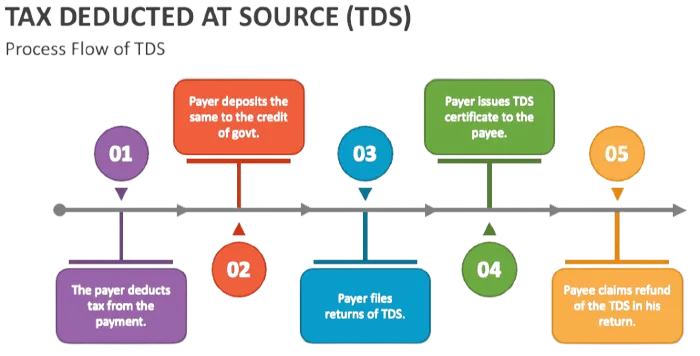
- The concept of TDS requires that the person on whom responsibility has been cast, is to deduct tax at the appropriate rates, from payments of specific nature which are being made to a specified recipient. The deducted sum is required to be deposited to the credit of the Central Government.
- The recipient from whose income tax has been deducted at source, gets the credit of the amount deducted in his personal assessment on the basis of the certificate issued by the deductor.
- While the statute provides for deduction of tax at source on a variety of payments of different nature, in this chapter, we will discuss various provisions relevant only to the salaried class of taxpayers, which means TDS done by the employer (Deductor) while paying the salary to the employee (Deductee).
Who is Involved in TDS?
- Deductor: The company or person making a payment (e.g. employer) who deducts tax before paying
- Deductee: The person receiving the payment (e.g. employee), whose income is taxed at source
Who is a Deductor and Deductee?
- The company or person that makes the payment after deducting TDS is called a deductor and the company or person receiving the payment is called the deductee.
- It is the deductor’s responsibility to deduct TDS before making the payment and deposit the same with the government.
- TDS is deducted irrespective of the mode of payment, whether cash, cheque or online, and is linked to the PAN of the deductor and the deductee.
PAN & TAN:
- PAN (Permanent Account Number) identifies the deductee
- TAN (Tax Deduction and Collection Account Number) identifies the deductor
TAN – Tax Deduction and Collection Account Number:
- TAN stands for Tax Deduction and Collection Account Number.
- It is a unique alphanumeric code assigned to entities or individuals who are responsible for deducting or collecting tax on behalf of the government.
- TAN serves as an identifier for tax deducted at source (TDS) or tax collected at source (TCS) transactions.
TDS Process Breakdown (Step-by-step for Salaries)
TDS deduction is not a simple process, and includes Remittance, Return Filing, Issue of Form 16, Credit in 26AS, etc. A brief explanation has been given below:
TDS Deduction:
Every month, while paying salary, the employer estimates the total annual salary and calculates the applicable tax slab (under Old or New Regime).
Deduction = [Estimated Annual Tax Liability] ÷ [No. of months in service]
Net Total Income = Gross Total Income – TDS
TDS Remittance:
- The deductor is required to deposit the TDS deducted to the credit of the Central Government within the prescribed time. Under Rule 218 of the Income-tax Rules, 2026, TDS deducted during a month is generally required to be deposited by the 7th of the following month.
- The deductor is required to furnish the prescribed challan/payment details while remitting the TDS amount to the Government.
TDS Statement Filing:
Employers deducting TDS from salary are required to furnish a quarterly statement of TDS deductions.
For salary TDS relating to periods governed by the Income-tax Act, 2025, the quarterly statement is furnished in Form No. 138, which replaces the erstwhile Form 24Q. Form 138 contains relevant details of salary and TDS, including::
- PAN of the employee
- Salary/income details
- TDS deducted
- TDS deposited
- Relevant details of the employee and deductor
The quarterly TDS statement enables the Income-tax Department to verify the tax deducted and deposited by the deductor and to provide appropriate tax credit to the taxpayer.
TDS statements are required to be furnished within the prescribed quarterly due dates.
Form 130 – Certificate of TDS on Salary (Earlier Form 16)
Under the Income-tax Rules, 2026, Form No. 130 is the certificate issued for TDS deducted from salary under Section 392 of the Income-tax Act, 2025.
It replaces the erstwhile Form 16 under the Income-tax Act, 1961.
Form 130 provides details such as:
- Salary/income paid to the employee
- TDS deducted
- PAN and TAN details
- Details of the employer and employee
- Tax computation and other prescribed particulars
Credit of TDS in Taxpayer’s Tax Statement (Form 26AS):
- The TDS deducted and reported by the deductor is reflected in the taxpayer’s tax information maintained by the Income-tax Department.
- The Annual Information Statement (AIS) and Taxpayer Information Summary (TIS) provide information relating to various financial transactions and tax-related information reported to the Income-tax Department.
- The tax deducted at source and other tax payments reported by the deductor/payee are used for providing credit while processing the taxpayer’s income-tax return, subject to applicable provisions and matching of the reported information.
- The Income-tax Rules, 2026 continue to prescribe Form No. 26AS as the Annual Information Statement.
| Earlier provisions | From 1 April 2026 |
|---|---|
| Section 192 – Salary TDS | Section 392 – Salary TDS |
| Form 24Q – Salary TDS return | Form 138 |
| Form 16 – Salary TDS certificate | Form 130 |
| Income-tax Act, 1961 | Income-tax Act, 2025 |
| Rule 30 | Rule 218 of Income-tax Rules, 2026 |