Instructions for Preparation of Financial Statement:
For the preparation of Financial Statement, one needs to follows certain instructions as per the Companies Act like Compliance and Disclosures.
Compliance includes that the format is followed and disclosure means certain additional information has to be reported, so that the users of the financial statement i.e. the shareholders understand the financials properly.

General Instructions:
1. Where any change in treatment or disclosure in the FS is required, including addition, amendment, substitution or deletion in the head or sub-head, the same shall be made and the requirements of this Schedule shall stand modified accordingly.
2. The disclosure requirements specified in Schedule III are in addition to the disclosure requirements specified in the Accounting Standards. Additional disclosures specified in the Accounting Standards or under any other law, shall be made in the notes to accounts unless required to be disclosed on the face of the Financial Statements.
3. Notes to accounts:
i. Notes to accounts shall contain information in addition to that presented in the Financial Statements and shall provide where required
- narrative descriptions or details of items recognized in those statements; and
- information about items that do not qualify for recognition in those statements.
ii. Each item on the face of the Balance Sheet and Profit and Loss shall be cross referenced to any related information in the notes to accounts.
4. Rounding off:
i. Depending upon the turnover of the company, the figures appearing in the Financial Statements may be rounded off as given below:
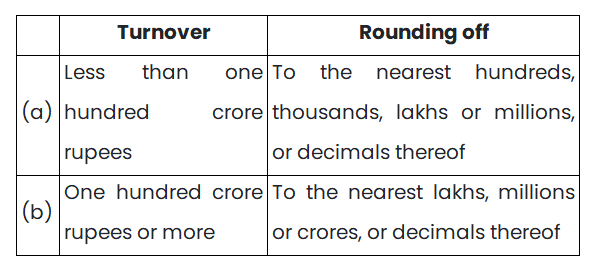
ii. Once a unit of measurement is used, it shall be used uniformly in the Financial Statements.
Disclosure of items in Notes (Balance sheet items):
General Instructions for Liabilities:
A liability shall be classified as current when it satisfies any of the following criteria:
- It is expected to be settled in the company’s normal operating cycle;
- It is held primarily for the purpose of being traded;
- It is due to be settled within twelve months after the reporting date; or
- The company does not have an unconditional right to defer settlement of the liability for at least twelve months after the reporting date.
- A payable shall be classified as a “trade payable” if it is in respect of the amount due on account of goods purchased or services received in the normal course of business.
- All other liabilities shall be classified as non-current.
1(a) Share Capital:
For each class of share capital (different classes of preference shares to be treated separately):
- the number and amount of shares authorized;
- the number of shares issued, subscribed and fully paid, and subscribed but not fully paid;
- par value per share
- a reconciliation of the number of shares outstanding at the beginning and at the end of the reporting period;
- shares in the company held by each shareholder holding more than 5 per cent. shares specifying the number of shares held;
1(b) Reserves & Surplus:
Reserves and Surplus shall be classified as:
- Capital Reserves;
- Capital Redemption Reserve;
- Debenture Redemption Reserve;
- Revaluation Reserve;
- Share Options Outstanding Account;
- Other Reserves-(specify the nature and purpose of each reserve and the amount in respect thereof);
- Surplus i.e., balance in Statement of Profit and Loss disclosing allocations and appropriations such as dividend, bonus shares and transfer to/ from reserves, etc.; (Additions and deductions since last balance sheet to be shown under each of the specified heads);
- Debit balance of statement of profit and loss shall be shown as a negative figure under the head “Surplus”.
1(c) Money received against share warrants:
- Money received against share warrants is the amount received by the company which is converted into shares at a specified date at a specified rate. The instrument is issued against the amount so received as share warrants. It is separately disclosed under the shareholder’s fund.
2. Share application money pending Allotment:
- Share Application Money Pending Allotment means the amount received on the application on which allotment is not yet made (pending allotment). The process starts when any company publicly issues its equity shares to raise funds.
- First, it receives the application money from its applicants and the equity shares are allotted to the respective applicants on a later date.
- Many times, the amount received by way of application is greater than what the company has issued equity for. In cases like this, until the shares are allotted, the amount received is shown under the Share Application Money Pending Allotment. Share Application Money Pending Allotment to the extent not refundable is included in Shareholders’ Fund.
3(a) Long-Term Borrowings:
i. Long-term borrowings shall be classified as:
- Bonds/debentures;
- Term loans: (A) from banks (B) from other parties
- Deferred payment liabilities;
- Deposits;
- Loans and advances from related parties;
- Long term maturities of finance lease obligations;
- Other loans and advances (specify nature)
ii. Borrowings shall further be sub-classified as secured and unsecured. Nature of security shall be specified separately in each case.
iii. Where loans have been guaranteed by Directors or others, the aggregate amount of such loans under each head shall be disclosed.
iv. Bonds/debentures (along with the rate of interest and particulars of redemption or conversion, as the case may be)
v. Particulars of any redeemed bonds/debentures which the company has power to reissue shall be disclosed.
vi. Terms of repayment of term loans and other loans shall be stated.
vii. Period and amount of continuing default as on the balance sheet date in repayment of loans and interest, shall be specified separately in each case.
3(b) Deferred Tax Liabilities (Net):
The tax effect due to the timing differences is termed as deferred tax which literally refers to the taxes postponed. Deferred tax is recognised on all timing differences – Temporary and Permanent.
These deferred taxes are given effect to in the financial statements through Deferred Tax Liability as under:

Common example of DTL would be depreciation.
When the depreciation rate as per the Income tax act is higher than the depreciation rate as per the Companies act (generally in the initial years), entity will end up paying less tax for the current period. This will create deferred tax liability in the books

3(c) Other Long-term Liabilities:
Other Long-term Liabilities shall be classified as:
(a) Trade payables;
(b) Others.
3(d) Long-term provisions:
The amounts shall be classified as:
(a) Provision for employee benefits;
(b) Others (specify nature).
4(a) Short-term borrowings:
i. Short-term borrowings shall be classified as:
(a) Loans repayable on demand;
(A) from banks.
(B) from other parties.
(b) Loans and advances from related parties;
(c) Deposits;
(d) Other loans and advances (specify nature).
ii. Borrowings shall further be sub-classified as secured and unsecured. Nature of security shall be specified separately in each case.
iii. Where loans have been guaranteed by Directors or others, the aggregate amount of such loans under each head shall be disclosed.
iv. Period and amount of default as on the balance sheet date in repayment of loans and interest, shall be specified separately in each case.
4(b) Trade Payables:
i. Short-term borrowings shall be classified as:
(a) Loans repayable on demand;
(A) from banks.
(B) from other parties.
(b) Loans and advances from related parties;
(c) Deposits;
(d) Other loans and advances (specify nature).
ii. Borrowings shall further be sub-classified as secured and unsecured. Nature of security shall be specified separately in each case.
iii. Where loans have been guaranteed by Directors or others, the aggregate amount of such loans under each head shall be disclosed.
iv. Period and amount of default as on the balance sheet date in repayment of loans and interest, shall be specified separately in each case.
4(c) Other current liabilities:
The amounts shall be classified as:
a. Current maturities of finance lease obligations;
b. Interest accrued but not due on borrowings;
c. Interest accrued and due on borrowings;
d. Income received in advance;
e. Unpaid dividends;
f. Application money received for allotment of securities and due for refund and interest accrued thereon.
g. Unpaid matured deposits and interest accrued thereon;
h. Unpaid matured debentures and interest accrued thereon;
i. Other payables (specify nature).
4(d) Short-term provisions:
The amounts shall be classified as:
- Provision for employee benefits.
- Provision for discount on debtors
- Provision for tax
- Provision for doubtful debts
- Others (specify nature).
General Instructions for Asset items:
An asset shall be classified as current when it satisfies any of the following criteria:
- It is expected to be realized in, or is intended for sale or consumption in, the company’s normal operating cycle;
- It is held primarily for the purpose of being traded;
- It is expected to be realized within twelve months after the reporting date; or
- It is cash or cash equivalent unless it is restricted from being exchanged or used to settle a liability for at least twelve months after the reporting date.
- A receivable shall be classified as a “trade receivable” if it is in respect of the amount due on account of goods sold or services rendered in the normal course of business.
- All other assets shall be classified as non-current.
5(a) Property, Plant and Equipment:
a. Classification shall be given as:
- Land;
- Buildings;
- Plant and Equipment;
- Furniture and Fixtures;
- Vehicles;
- Office equipment;
- Others (specify nature).
b. Assets under lease shall be separately specified under each class of asset.
c. A reconciliation of the gross and net carrying amounts of each class of assets at the beginning and end of the reporting period showing additions, disposals, acquisitions through business combinations, amount of change due to revaluation
5(b) Non-current investments:
Non-current investments shall be classified as trade investments and other investments and further classified as:
(a) Investment property;
(b) Investments in Equity Instruments;
(c) Investments in preference shares;
(d) Investments in Government or trust securities;
(e) Investments in debentures or bonds;
(f) Investments in Mutual Funds;
(g) Investments in partnership firms;
(h) Other non-current investments (specify nature).
5(c) Deferred Tax Assets (Net):
The tax effect due to the timing differences is termed as deferred tax which literally refers to the taxes postponed. Deferred tax is recognised on all timing differences – Temporary and Permanent.
These deferred taxes are given effect to in the financial statements through Deferred Tax Asset as under:

Example of Deferred Tax Asset:
- DTA – Suppose, book profit of an entity before taxes is Rs.1000 and this includes provision for bad debts of Rs.200.
- For the purpose of tax profit, bad debts will be allowed in future when it’s actually written off. Hence taxable income after this disallowance will be Rs.1200 and let’s say income tax rate is 20% then the entity will pay taxes on Rs.1200 i.e., (1200*20%) Rs.240.
- If bad debts were not disallowed, entity would have paid tax on Rs.1000 amounting Rs.200 i.e., 1000*20%. For the additional Rs.40 which is already paid now, we have to create DTA. Entry for recording the DTA is as under:
Deferred Tax Asset Dr. 40
To Deferred Tax Expense Cr 40
(Being DTA of Rs.40 accounted in the books)
5(d) Long-term loans and advances:
Long-term loans and advances shall be classified as:
a. Capital Advances;
b. Loans and advances to related parties (giving details thereof);
c. Other loans and advances (specify nature).
i. The above shall also be separately sub-classified as:
a. Secured, considered good;
b. Unsecured, considered good;
c. Doubtful.
ii. Allowance for bad and doubtful loans and advances shall be disclosed under the relevant heads separately.
iii. Loans and advances due by Directors or other officers of the company or any of them either severally or jointly with any other persons or amounts due by firms or private companies respectively in which any director is a partner or a director or a member should be separately stated
5(e) Other non-current assets:
Other non-current assets shall be classified as:
a. Long-term Trade Receivables (including trade receivables on deferred credit terms); like Security Deposits]
b. Others (specify nature);
c. Long term Trade Receivables, shall be sub-classified as:
- Secured, considered good;
- Unsecured, considered good;
- Doubtful
d. Allowance for bad and doubtful debts shall be disclosed under the relevant heads separately.
e. Debts due by Directors or other officers of the company or any of them either severally or jointly with any other person or debts due by firms or private companies respectively in which any director is a partner or a director or a member should be separately stated.
6(a) Current Investments:
Current investments shall be classified as:
- Investments in Equity Instruments;
- Investments in Preference Shares;
- Investments in Government or trust securities;
- Investments in debentures or bonds;
- Investments in Mutual Funds;
- Investments in partnership firms;
- Other investments (specify nature).
The following shall also be disclosed:
- The basis of valuation of individual investments;
- Aggregate amount of quoted investments and market value thereof;
- Aggregate amount of unquoted investments;
- Aggregate provision made for diminution in value of investments.
6(b) Inventories:
i. Inventories shall be classified as:
- Raw materials;
- Work-in-progress;
- Finished goods;
- Stock-in-trade (in respect of goods acquired for trading);
- Stores and spares;
- Loose tools;
- Others (specify nature).
ii. Goods-in-transit shall be disclosed under the relevant sub-head of inventories.
iii. Mode of valuation shall be stated.
6(c) Trade Receivables:
i. Trade receivables shall be sub-classified as:
a. Secured, considered good;
b. Unsecured, considered good;
c. Doubtful.
ii. Allowance for bad and doubtful debts shall be disclosed under the relevant heads separately.
iii. Debts due by Directors or other officers of the company or any of them either severally or jointly with any other person or debts due by firms or private companies respectively in which any director is a partner or a director or a member should be separately stated.
6(d) Cash and cash equivalents:
i. Cash and cash equivalents shall be classified as:
a. Balances with banks;
b. Cheques, drafts on hand;
c. Cash on hand;
d. Others (specify nature).
ii. Earmarked balances with banks (for example, for unpaid dividend) shall be separately stated.
iii. Balances with banks to the extent held as margin money or security against the borrowings, guarantees, other commitments shall be disclosed separately.
iv. Repatriation restrictions, if any, in respect of cash and bank balances shall be separately stated.
v. Bank deposits with more than twelve months maturity shall be disclosed separately.
6(e) Short-term loans and advances:
i. Short-term loans and advances shall be classified as:
- Loans and advances to related parties (giving details thereof);
- Others (specify nature).
ii. The above shall also be sub-classified as:
- Secured, considered good;
- Unsecured, considered good;
- Doubtful.
iii. Allowance for bad and doubtful loans and advances shall be disclosed under the relevant heads separately.
iv. Loans and advances due by Directors or other officers of the company or any of them either severally or jointly with any other person or amounts due by firms or private companies respectively in which any director is a partner or a director or a member shall be separately stated.
6(f) Other current assets (specify nature):
This is an all-inclusive heading, which incorporates current assets that do not fit into any other asset categories.
Contingent liabilities and commitments (to the extent not provided for)
(i) Contingent liabilities shall be classified as:
- Claims against the company not acknowledged as debt;
- Guarantees;
- Other money for which the company is contingently liable.
(ii) Commitments shall be classified as:
- Estimated amount of contracts remaining to be executed on capital account and not provided for;
- Uncalled liability on shares and other investments partly paid;
- Other commitments (specify nature)
Disclosure of items in Notes to accounts (Statement of Profit and Loss items)
I. Revenue from operations
A. In respect of a company other than a finance company revenue from operations shall disclose separately in the notes revenue from
- Sale of products;
- Sale of services; [Grants or donations received (relevant in case of section 8 companies only),]
- Other operating revenues;
- Less:
- Excise duty
B. In respect of a finance company, revenue from operations shall include revenue from—
- Interest; and
- Other financial services
II. Other income:
Other income shall be classified as:
- Interest Income (in case of a company other than a finance company);
- Dividend Income;
- Net gain/loss on sale of investments;
- Other non-operating income (net of expenses directly attributable to such income).
III. Total Revenue:
Total Revenue = Revenue from operations (I) + Other income (II)
IV. Expenses:
Cost of materials consumed:
- Applicable only to manufacturing companies
- Where packing materials are not classified as raw materials, consumption thereof – materials, consumption thereof – disclose separately disclose separately
- Stores, fuel, spare parts etc. do not enter physically into the product, to be disclosed separately.
- Company should provide for actual consumption and not the derived consumption. In case derived consumption is taken – consumption is taken – suitable footnote suitable footnote
- Shortages / wastages if within norms of acceptable margin, should form part of consumption. Abnormal variations to be disclosed separately.
Purchases of Stock-in-Trade:
1. In the case of manufacturing companies—
- Raw materials under broad heads.
- goods purchased under broad heads.
2. In the case of trading companies, purchases in respect of goods traded in by the company under broad heads.
3. In the case of companies rendering or supplying services, gross income derived from services rendered or supplied under broad heads.
4. In the case of all concerns having works in progress, works-in-progress under broad heads.
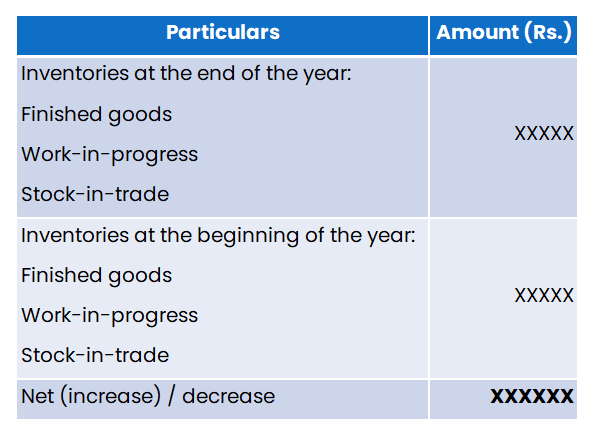
Changes in inventories of finished goods, work-in-progress and Stock-in-Trade:
Change in inventory means difference between total of opening and closing inventories. Opening inventories and closing include all raw material, work-in-progress and finished goods of inventory.
Employee benefits expense Finance costs:
Employee benefit expenses:
1. Salaries and wages,
- Bonus
- Leave encashment
- Compensations
2. Contribution to provident and other funds,
- Gratuity funds,
- Superannuation funds
- Penalties and similar amounts not to be disclosed here
3. expense on Employee Stock Option Scheme (ESOP) and Employee Stock Purchase Plan (ESPP),
4. staff welfare expenses
Finance costs:
1. Interest expense:
- Interest on borrowings, debentures, bonds, etc.
- Finance charges on finance lease are in nature of interest
2. Other borrowing costs:
- Commitment charges
- Loan processing charges
- Guarantee charges
- Loan facilitation charges
- Discounts/ premium on borrowings
- Other ancillary costs
3. Applicable net loss on foreign currency transactions to the extent they are regarded as adjust to interest cost
Depreciation and amortisation expense:
- Depreciation is the systematic allocation of the depreciable amount of an asset over its useful life. The depreciable amount of an asset is the cost of an asset or other amount substituted for cost, less its residual value. The useful life of an asset is the period over which an asset is expected to be available for use by an entity, or the number of production or similar units expected to be obtained from the asset by the entity.
- For the purpose of this Schedule, the term depreciation includes amortization.
To understand in detail about the depreciation rates refer “SCHEDULE II — RATE OF DEPRECIATION — THE COMPANIES ACT, 2013”
By referring above schedule we can understand to compute depreciation as per Schedule II along with Section 123 of the Companies Act, 2013
Other Expenses:
- Interest expense;
- Net gain/loss on sale of investments;
- Adjustments to the carrying amount of investments;
- Net gain or loss on foreign currency transaction and translation (other than considered as finance cost);
- Payments to the auditor as (a) auditor; (b) for taxation matters; (c) for company law matters; (d) for management services; (e) for other services; and (f) for reimbursement of expenses;
- In case of Companies covered under section 135, amount of expenditure incurred on corporate social responsibility activities;
- Details of items of exceptional and extraordinary nature;
- Prior period items;
- Expenditure incurred on each of the following items, separately for each items:
- Consumption of stores and spare parts;
- Power and fuel;
- Rent;
- Repairs to buildings;
- Repairs to machinery;
- Insurance;
- Rates and taxes, excluding, taxes on income;
- Miscellaneous expenses,