TDS to be deducted against payment of Interest
- Interest on securities
- TDS from Interest other than interest on securities
Section 393(1) [Earlier Section 193] – TDS on Interest on Securities
What is “Interest on Securities”?
Interest on securities issued by Central/State Governments, local authorities, companies, or statutory corporations. (Equity shares and equity mutual funds remain excluded as they do not yield interest).
Person responsible for deduction of tax at source:
Who Must Deduct TDS? Any person (other than individual/HUF not liable to tax audit) responsible for paying interest on securities to a resident must deduct TDS:
- At the time of Credit of interest to the account of the payee, or
- At the time of payment, whichever is earlier
Applicable TDS Rate (Tax Year 2026-27):
- 10% if PAN is provided
- 20% if PAN is NOT provided
- Nil if a valid self-declaration under Form 121 (formerly Form 15G/15H) is furnished.
Threshold Limits:
- ₹10,000 per tax year
- TDS is required where the interest on securities exceeds the applicable threshold of ₹10,000.
| Particulars | Old Act – Section 193 | New Act – TY 2026-27 |
|---|---|---|
| Threshold for interest on securities | Old provisions had specific limits depending on security | ₹10,000 |
| New Section | 193 | 393(1), Table 5(i) |
| Code | 193 | 1019 |
| Rate | 10% | 10% |
Exemption:
No TDS is required in respect of specified securities/incomes covered by the exemption provisions.
Important specified categories include:
- National Development Bonds;
- Specified debentures issued by notified institutions/authorities/persons;
- Securities of the Central Government or State Government, subject to the exclusions specified in the Act;
- Interest payable to specified insurers in respect of securities owned by them;
- Interest payable to a business trust in specified circumstances.
Form 121 (Ealier 15G/ 15H):
Form 121 is prescribed under Section 393(6) read with Rule 211 of the Income-tax Rules, 2026. Form No. 121 is a statutory declaration, through which a taxpayer declares that tax liability on its estimated total income for the relevant tax year is nil. Based on this declaration, the payer (deductor) is permitted to not deduct tax at source (TDS) on specified payments.
Why was Form No. 121 introduced, replacing Forms 15G and 15H?
Form No. 121 has been introduced as part of a broader effort to simplify tax compliance and align forms with the new Income-tax Act, 2025. Earlier:
- Form 15G was used by individuals below 60 years & other person such as HUF, Trusts etc.
- Form 15H was used by senior citizens (60 years or above)
The introduction of Form No. 121 merges both forms into a single, unified declaration, reducing duplication and confusion. It also introduces:
- Better structuring of fields (separate fields for PAN, name, etc.)
- Alignment with “Tax Year” terminology instead of “Previous Year”
- Enhanced compatibility with electronic filing systems
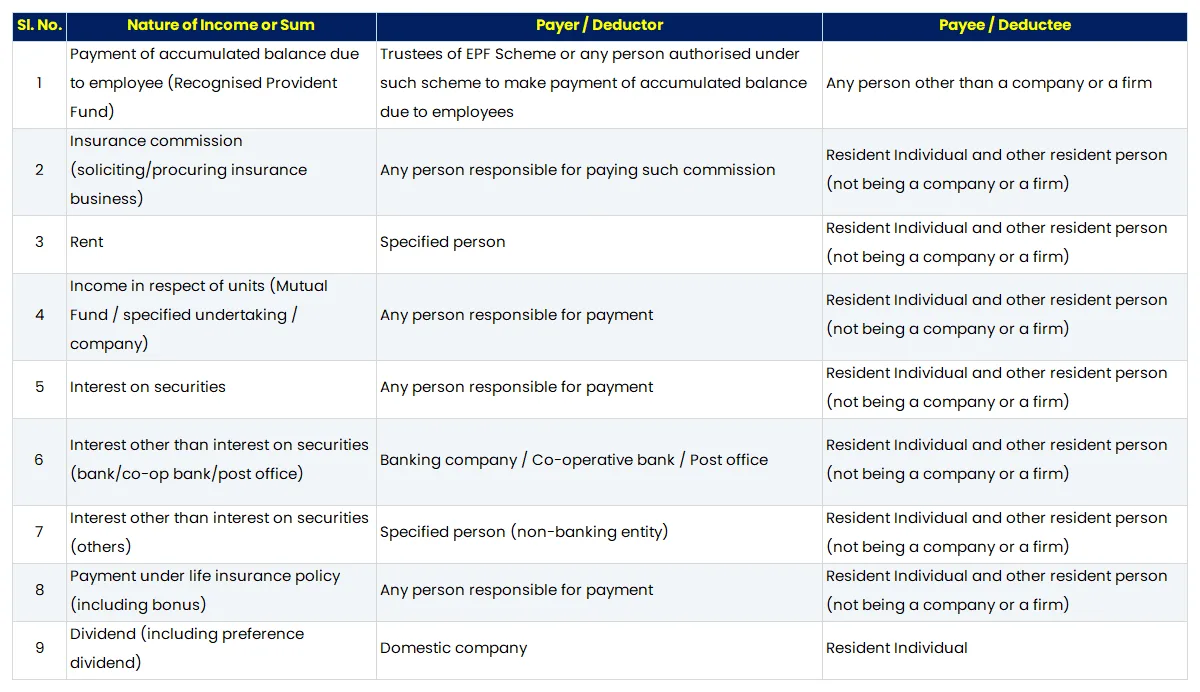
Form No.121 applies to specific categories of income where TDS is generally required but may be avoided through declaration. The types of income along with applicable category of payer and payee are provided in the table below:
2. TDS from Interest other than interest on securities:
| Old Section | New Section | Table | Code | Nature |
|---|---|---|---|---|
| 194A | 393(1) | 5(ii).D(a) | 1020 | Interest other than securities – Senior Citizen – Bank/Co-op Bank/Post Office |
| 194A | 393(1) | 5(ii).D(b) | 1021 | Interest other than securities – Other than Senior Citizen – Bank/Co-op Bank/Post Office |
| 194A | 393(1) | 5(iii) | 1022 | Interest other than securities – Specified person |
What is “Interest other than Interest on Securities”?
- Interest on Fixed Deposits;
- Interest on Recurring Deposits;
- Interest on other time deposits;
- Interest on deposits with banks;
- Interest on deposits with co-operative banks;
- Certain post-office deposits;
- Other interest payments covered by the specified-person provisions.
A. Interest paid by Bank / Co-operative Bank / Post Office
This is covered under Section 393(1), Table Sl. No. 5(ii)
There are two thresholds.
| Payee | Threshold |
|---|---|
| Senior Citizen | ₹1,00,000 |
| Other than Senior Citizen | ₹50,000 |
Rate of TDS:
The rate at which tax is to be deducted is 10%
B. Interest paid by Other Specified Persons
Where the payer is a specified person other than the bank/co-operative bank/post office category:
Section 393(1), Table Sl. No. 5(iii)
| Particular | TY 2026-27 |
|---|---|
| New provision | 393(1), Table 5(iii) |
| Code | 1022 |
| Rate – Resident | 10% |
| Threshold | ₹10,000 |
Who is a “Specified Person”?
An individual/HUF becomes subject to TDS where the prescribed business/professional turnover conditions are satisfied in the preceding tax year.
Broadly:
Business
- Turnover/gross receipts exceeding ₹1 crore
Profession
- Gross receipts exceeding ₹50 lakh
Therefore, an ordinary individual/HUF who does not cross the prescribed limit is generally not required to deduct TDS merely because they pay interest.
Specific Exemptions:
TDS under the interest provisions is not applicable to specified exempt categories.
1. Interest paid by a partnership firm to its partners.
2. Interest paid to certain entities like:
- Banking companies, Co-operative banks engaged in banking.
- Financial corporations established under Central, State, or Provincial Act.
- Life Insurance Corporation of India (LIC).
- Unit Trust of India (UTI).
- Certain other notified institutions, associations, or bodies.
3. Interest credited or paid on deposits with a primary agricultural credit society, primary credit society, co-operative land mortgage bank, or co-operative land development bank.
4. Interest income credited/paid relating to the Compensation Amount awarded by the Motor Accidents Claims Tribunal (up to Rs. 50,000).