TDS on Salary (Sec 392)
Section 392(1) of the Income-tax Act, 2025 provides for deduction of tax at source from income chargeable under the head “Salaries.”
Where any income chargeable under the head “Salaries” is payable by an employer to an employee, the employer is required to deduct income-tax at the average rate of income-tax computed on the basis of the rates in force for the relevant Tax Year, on the estimated income of the employee under the head “Salaries” for that Tax Year.
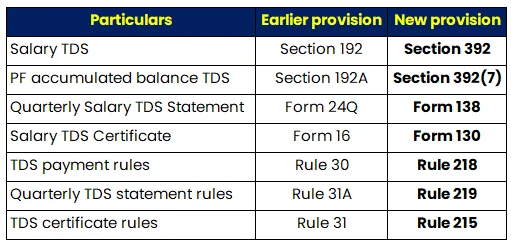
The salary-TDS provisions under the new Act broadly retain the same mechanism as the earlier Section 192, with the provisions reorganised under Section 392.
Person responsible for deduction of tax
The responsibility for deducting tax from salary arises where there is an employer-employee relationship.
For a payment to be taxable under the head “Salaries”, there should generally be an employer-employee relationship. The employer is responsible for estimating the employee’s taxable salary income and deducting the applicable TDS.
Thus, TDS on salary is applicable when:
- There is an employer-employee relationship;
- Payment is made by the employer to the employee;
- The payment is chargeable to tax under the head “Salaries”; and
- The estimated taxable salary exceeds the applicable maximum amount not chargeable to tax for the relevant Tax Year.
Persons Responsible for Deduction
For different categories of employers, the person responsible for deduction of tax may be:
- Central Government / State Government / PSU – The designated Drawing and Disbursing Officer (DDO).
- Private and Public Companies – The company and the principal officer responsible for making the payment.
- Firm – The managing partner or partner responsible for making the payment.
- HUF – The Karta of the HUF.
- Proprietorship Concern – The proprietor.
- Trust – The trustee/person responsible for making the payment.
Time of deduction of tax:
Under Section 392, TDS on salary is required to be deducted at the time of payment of salary.
The liability to deduct TDS does not arise merely because salary expenditure is recorded in the books. The relevant point is the payment of salary. Therefore:
- Salary credited in the books but not paid does not by itself trigger salary TDS merely because the expense entry is passed.
- TDS is required to be deducted when salary is actually paid.
- Advance salary and arrears of salary are also considered while determining the TDS liability.
Rate of deduction of tax:
- Under Section 392, tax on salary is deducted at the average rate of income-tax computed on the basis of the rates in force for the relevant Tax Year.
- The employer does not apply a fixed TDS rate such as 10% or 20% to the entire salary. Instead, the employer estimates the employee’s annual taxable income and calculates the total tax liability according to the applicable tax regime and tax rates.
- The total estimated tax liability is then spread over the remaining salary payments during the Tax Year.
Average rate of deduction:
The employer is required to:
- Estimate the employee’s total salary income for the relevant Tax Year.
- Consider taxable salary, including applicable perquisites and profits in lieu of salary.
- Consider other income and eligible claims furnished by the employee, wherever permitted.
- Consider applicable exemptions, deductions, rebates and reliefs.
- Calculate the employee’s estimated total tax liability according to the rates in force.
- Deduct TDS at the average rate from salary payments during the Tax Year.
Example
If the estimated annual tax liability of an employee is ₹1,20,000 and there are 12 salary payments in the Tax Year, the employer may generally deduct ₹10,000 per month, subject to adjustments for changes in salary, deductions, exemptions, tax declarations and TDS already deducted.
Points to remember:
- TDS on salary is governed by Section 392 of the Income-tax Act, 2025 for payments governed by the new Act.
- TDS is deducted at the time of payment of salary.
- The employer calculates TDS based on the estimated annual salary income.
- Tax is deducted at the average rate of income-tax applicable to the employee.
- Both monetary and taxable non-monetary perquisites are considered for determining salary income.
- The employer may consider eligible information, evidence and claims furnished by the employee for determining the amount of TDS.
- Advance salary, arrears, bonus, commission and other taxable salary components are taken into account while computing TDS.
- The employer can adjust any excess or shortfall in TDS during subsequent deductions in the same Tax Year.
- The TDS deducted must be deposited with the Central Government within the prescribed time.
- The employer is required to furnish the prescribed quarterly TDS statement.
- The salary TDS certificate under the new Rules is Form No. 130, which replaces the erstwhile Form 16.
- The quarterly salary TDS statement is Form No. 138, which replaces the erstwhile Form 24Q.
Adjustment of Excess or Shortfall in TDS
The employer can make adjustments for any excess deduction or shortfall in deduction during the same Tax Year.
For example:
Increase in TDS
If the employee receives:
- Arrears of salary;
- Bonus;
- Commission;
- Salary increment;
- Additional taxable perquisites; or
- Any other taxable salary income,
the employer may increase the subsequent TDS deductions to account for the additional tax liability.
Reduction in TDS
Similarly, if the employee subsequently furnishes eligible information or evidence relating to deductions, exemptions, reliefs or other permitted claims, the employer may take such information into account while determining the remaining TDS liability.
The objective is to ensure that the total TDS deducted during the Tax Year approximates the employee’s final tax liability.
TDS on Withdrawal of Provident Fund (Sec 392(7)):
- Under Section 392(7) of the Income-tax Act, 2025, TDS is applicable on payment of the accumulated balance due to an employee participating in a Recognised Provident Fund, where the accumulated balance is includible in the employee’s total income.
- The trustees of the Employees’ Provident Funds Scheme, 1952, or any person authorised under the scheme to make such payment, are responsible for deducting tax.
- Rate of TDS – 10% (20% if the employee doesn’t have a valid PAN)
- Threshold – TDS is required where the aggregate amount of such payment is ₹50,000 or more, provided the accumulated balance is taxable in the hands of the employee. The provision applies where the exemption conditions under the relevant provision of Schedule XI are not satisfied.
Example
- An employee withdraws ₹80,000 from a Recognised Provident Fund and the accumulated balance is taxable because the prescribed exemption conditions are not satisfied.
- Since the payment exceeds ₹50,000, TDS is required under Section 392(7) at 10%, subject to the applicable provisions.
Salary TDS – New Forms from 1 April 2026
With effect from 1 April 2026, the Income-tax Rules, 2026 introduce new forms for TDS compliance.