Introduction to TDS (Other than on Salary)
What is TDS (Other than on Salary)?
Tax Deducted at Source (TDS) is not limited to salaries alone! The Income Tax Act, 2025 mandates deduction of tax at source on various non-salary payments as well. These include interest, rent, contractor payments, commission, professional fees, and many more.
TDS – Tax Deducted at Source:
1. Tax:
Tax refers to a mandatory financial contribution made by individuals or entities to the Government. This contribution supports national development by funding areas such as infrastructure, public services, healthcare, education, defense, and more.
- In essence, tax is a contribution made by citizens and businesses for the functioning of the nation.
2. Deducted:
The term “deducted” implies that a certain portion of income is withheld at the time of payment by the person or entity making the payment.
- The person who deducts the tax is known as the Deductor.
- The person from whose income tax is deducted is known as the Deductee.
- This mechanism ensures that taxes are collected in advance, rather than waiting for the full amount to be paid at the end of the financial year.
- This system follows the principle of “Pay as income is earned.”
- Example: If ₹50,000 is being paid as professional fees and TDS @ 8% under Section 194J(A) of the Income Tax Act, 2025 is applicable, ₹4,000 will be deducted and deposited by the deductor, and the deductee will receive ₹46,000.
3. Source:
“Source” here refers to the origin or type of income being paid.
- Salary
- Income from House Property (e.g., Rent)
- Income from Other Sources (e.g., Interest)
- Profits and Gains from Business or Profession
- Capital Gains
Who is Required to Deduct TDS?
Mandatory Deductors
Individuals, HUFs, Firms, Companies, AOPs, BOIs etc., carrying out business or profession where turnover exceeds limits under the Income Tax Act, 2025 (i.e., audit limits) are required to deduct TDS.
Exempted Entities
Individuals or HUFs not liable to audit under the Income Tax Act, 2025 are generally not required to deduct TDS in most cases.
TDS Deduction & Deposit Cycle
Step-by-Step Process:
1
Deduction
At the time of payment/credit (whichever is earlier), deduct TDS at the prescribed rate.
2
Deposit
- Due Date: 7th of next month for most cases; 30th April for March TDS.
3
TDS Return Filing
- Quarterly Filing of returns in Form 140 (for all non-salary TDS).
- Due Dates: Q1 (Apr–Jun): 31st July Q2 (Jul–Sep): 31st October Q3 (Oct–Dec): 31st January Q4 (Jan–Mar): 31st May
4
TDS Certificate
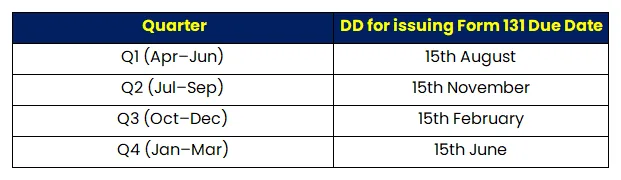
- Form 131 to be issued to Deductee as proof of deduction.
- Due within 15 days of return filing due date.
5
Credit to Deductee
- Reflected in Form 26AS and Annual Information Statement (AIS) on the Income Tax Portal.
Form 131 – TDS Certificate for Non-Salary Income
Form 131 is a certificate of TDS deduction issued for all types of income except salary. It is issued by the Deductor to the Deductee after deducting TDS on payments like:
- Professional or Technical Fees
- Rent
- Commission or Brokerage
- Interest (other than interest on securities)
- Contractual Payments
- Consultancy services, etc.
Due Date for issuing Form 131 by the Deductor to Deductee
Form 168 (Earlier Form 26AS) – Tax Credit Statement
Form 168 is a comprehensive tax credit statement available on the Income Tax portal, summarizing all TDS deducted, advance tax paid, and high-value transactions associated with a PAN. This includes:
- TDS on Salary (Form 130)
- TDS other than Salary (Form 131)
- TCS (Tax Collected at Source)
- Advance Tax / Self-Assessment Tax
- Refunds Received
- High-value financial transactions (e.g., credit card spends, property purchases)
Where to Find Form 168 (Earlier Form 26AS)?
Can be accessed from the TRACES portal or via the Income Tax e-filing website through PAN login.
TDS on Other than Salary
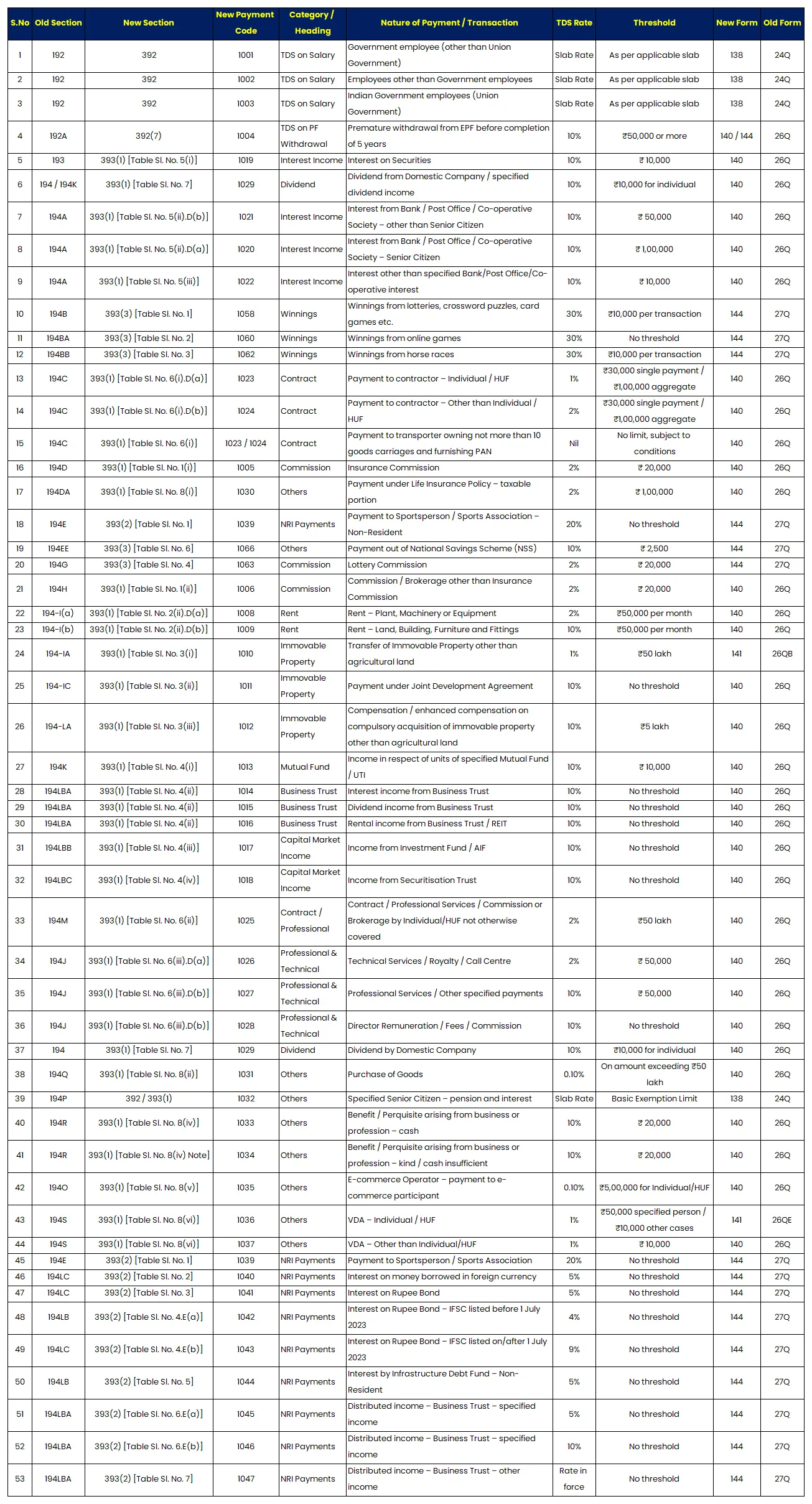
The statutory provision regarding deduction of tax at source is dealt in the Income-tax Act, 2025 which gives the details of the relevant provisions of TDS, the rates and also the exemptions where no tax is to be deducted.
The following payments are subject to tax deduction at source:
TDS Payments (Income Tax Act, 2025) Section 393(1)
Interest Code (1020, 1021 & 1022)
Dividends (Code 1015)
Rent (Code 1008 & 1009)
Contract Payments (Code 1023 & 1024)
Professional Fees (Code 1026, 1027 & 1028)
Commission/Brokerage (Code 1006)
Winnings from Lottery (Code 1058 & 1059)
Winnings from Horse Race (Code 1062)
Income Tax TDS on the GST component of the invoice:
When making payments for services like contract work, rent, or professional services, there’s often confusion about whether TDS should be deducted on the full invoice amount (including GST) or only on the base amount excluding GST.
To clarify this, the CBDT issued Circular No. 35/2024, which states:
- If GST on services is shown separately in the invoice, then TDS should be deducted only on the base amount, excluding the GST component.
Example:
- If a professional charges ₹1,00,000 + ₹18,000 GST = ₹1,18,000 total,
- TDS will be deducted only on ₹1,00,000, not on ₹1,18,000.
Time Limit For Deposit Of TDS
The tax should be deducted at the time of-
- Passing such entry in the accounts or
- Making the actual payment of the expense, whichever is earlier.
TDS Sections Summary