Payroll and Salary Statement

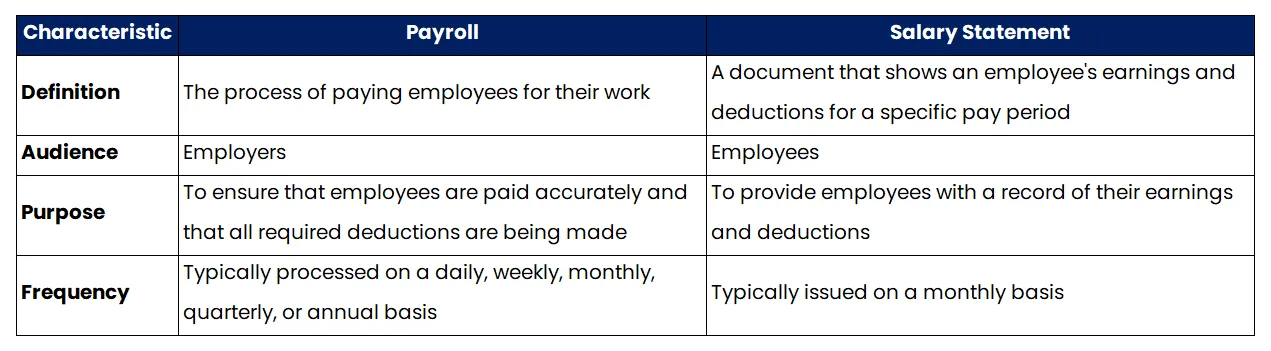
Payroll and salary statement are not the same.
- Payroll is the process of paying employees for their work. It includes tracking hours worked, calculating pay, and distributing payments.
- Salary statement is a document that shows an employee’s earnings and deductions for a specific period.
Payroll is the recurring payment of an employee’s salary by an employer, typically on a daily, weekly, monthly, quarterly, or annual basis, for the work performed during that period.
Steps in Payroll Preparation
- Payroll Data Collection: It is the process of gathering and maintaining accurate employee information, such as personal details, tax forms, and employment contracts, which is essential for payroll processing.
- Calculating Gross Pay: It is calculated based on a variety of factors, such as regular hours worked, overtime hours worked, commissions, bonuses, and other earnings.
- Deductions and Withholdings: Payroll also includes deducting various amounts from gross pay, such as income tax, Social Security (PF, ESI) contributions, health insurance premiums, retirement plan contributions, and other voluntary deductions.
- Tax Compliance: Tax compliance is crucial for employers, as they are responsible for withholding (TDS) the correct amount of income tax from employee earnings and remitting it to the tax authorities (Income Tax Department).
- Payroll Reporting: Generating payroll reports, such as payroll registers, tax reports, and year-end statements, helps employers keep accurate records and comply with reporting requirements.
Breakdown of Salary:
- Gross Salary
- Deductions
- Net Salary

“Gross”, “deductions”, and “net” are terms often used to describe an employee’s salary or income. Here is what each term means:
- Gross income or salary is the total amount of money an employee earns before any deductions or taxes are applied. It is the employee’s initial earnings, including base salary, bonuses, overtime pay, and any other forms of compensation.
- Deductions are the amounts of money that are subtracted from an employee’s gross income to cover various obligations and expenses. Common deductions include income tax, Social Security contributions, Medicare contributions, health insurance premiums, retirement plan contributions, and other mandated or voluntary deductions.
- Net income or net salary is the amount of money an employee receives after all deductions and taxes have been subtracted from their gross income. It is the employee’s take-home pay, which is the actual amount of money they have available for personal expenses.
The relationship between gross income, deductions, and net income can be summarized with the following equation:
Net income = Gross income – Deductions
Employees must understand their net income to budget and plan their finances effectively, as it represents the amount of money they have available for spending and saving after all necessary deductions have been made.