Computation of TDS on Salary
Computing TDS on salary involves estimating the employee’s taxable income for the tax year, considering eligible exemptions and deductions, applying the applicable tax rates and rebate provisions, and deducting the resulting tax from salary.
For Tax Year 2026-27 onwards, salary TDS is governed by Section 392 of the Income-tax Act, 2025. The corresponding provisions under the Income-tax Act, 1961 were primarily contained in Section 192.
The computation of TDS on salary can be broadly understood through the following steps:
- Determine the Salary Components
- Compute Estimated Salary Payable to the Employee during the Tax Year
- Add Salary from Previous Employer and Other Income
- Calculate Taxable Income and TDS considering Form 124
- Re-compute Taxable Income and TDS
- Remit the TDS to the Government
Step 1: Determine the Salary Components:
The first step in computing TDS is to identify all salary components payable to the employee during the tax year.
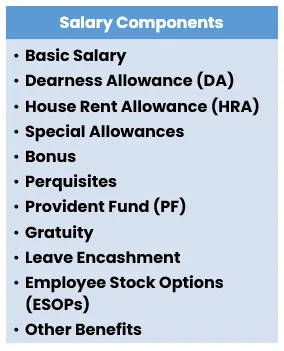
Determining salary components is the first step in computing TDS (Tax Deducted at Source) on salary. Salary components can vary from one person to another and from one employer to another, but they typically include the following:
- Basic Salary: This is the fixed component of salary and forms the foundation for various other allowances and deductions. This is fully taxable.
- Dearness Allowance (DA): DA is an allowance paid to employees as a cost-of-living adjustment (inflation) and is fully taxable.
- House Rent Allowance (HRA): If employee lives in a rented house, they may receive HRA as part of their salary. HRA can be partially exempt from taxation if they meet certain conditions.
- Special Allowances: These can include various allowances like conveyance allowance, medical allowance, travel allowance, etc. Some allowances may be fully taxable, while others might be partially or fully exempt under certain conditions.
- Bonus: Any performance-related or annual bonuses are typically part of salary and are taxable.
- Perquisites: These are non-cash benefits provided by employer, such as a company car, accommodation, or club memberships. Perquisites are taxable.
- Provident Fund (PF): Employee contribution to the Employee Provident Fund (EPF) and any Voluntary Provident Fund (VPF) contributions are part of salary but eligible for deductions under Section 80C.
- Gratuity: Gratuity received is part of salary but eligible for tax exemptions based on certain conditions.
- Leave Encashment: If employee receive payment for unused accumulated leave when they quit the job, it becomes part of the salary and is taxable.
- Employee Stock Options (ESOPs): If employee receive ESOPs from their employer, they are considered part of salary and may have different tax treatment, including taxation at the time of exercise or sale.
- Other Benefits: Employer may provide other benefits like food coupons, health insurance, or retirement benefits, which may be part of salary.
- Variable Pay: Some employees receive variable pay or incentives based on their performance or company’s performance. This is also considered a part of salary.
It’s essential to carefully review salary structure and payslips to identify all these components. Keep in mind that not all components are fully taxable, and some may be eligible for tax exemptions or deductions. Understanding the tax treatment of each component is crucial for accurate TDS calculation and tax planning.
Additionally, employers typically provide a Form 130 (Previously Known as Form 16) at the end of the financial year, which includes details of income components and TDS deductions. This can serve as a useful reference when computing income tax liability.
Step 2: Compute Estimated Salary Payable to the Employee during the tax year
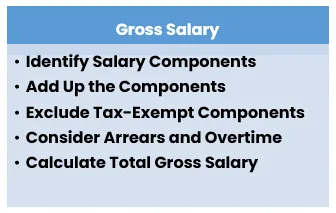
Estimated Salary Payable to the Employee during the year
- Identify Salary Components: Identify all the components of salary as discussed in Step 1.
- Identify Gross Salary for the Month: Once components are identified, simply add them up. Gross salary for the month is the sum of all these components. Gross Salary = Basic Salary + HRA + Special Allowances + DA + Bonus + Perquisites +PF Contribution + Gratuity + Leave Encashment + ESOP Income + Other Benefits.
- Consider Arrears and Overtime: If arrears or overtime pay are planned to be paid during the period, while calculating the gross salary, include these amounts as well.
- Estimate the Salary Payable for the year: Multiply the monthly gross salary with number of months in the financial year.
Eg: Gross Salary per month is Rs.1,00,000 for an existing employee. Estimated salary for the year would be Rs.1,00,000 X 12 = 12,00,000
2
Step 3: Add Salary from Previous Employer and Other Income
An employee may change employment during the tax year. In such a case, the current employer needs relevant information about salary received from the previous employer and other income so that appropriate TDS can be calculated.
Form No. 122 – Details of Previous Employer Salary and Other Income
An employee may also furnish details of income from other heads, such as:
- Income from House Property
- Interest income
- Dividend income
- Other taxable income
Where the employee provides the relevant details in the prescribed manner, the employer may consider the applicable income/loss while computing TDS under Section 392.
Note: Form No. 122 specifically provides for furnishing details of income under other heads and loss under the head Income from House Property.
Step 4: Calculate Taxable Income and TDS considering the Form 124
Once estimated salary and other relevant income are determined, the employer computes taxable income after considering eligible exemptions and deductions.
Form No. 124 – Employee’s Claims for TDS
For Tax Year 2026-27 onwards, Form No. 124 replaces Form 12BB.
Form No. 124 is prescribed under Section 392(5)(b) of the Income-tax Act, 2025 read with Rule 205 of the Income-tax Rules, 2026.
The employee furnishes Form No. 124 to the employer for claiming eligible:
- HRA exemption
- Leave Travel Concession/Assistance
- Interest on housing loan
- Deductions under the applicable provisions
- Other eligible exemptions/deductions
The employee should also provide the prescribed supporting evidence wherever required.
A. Determine Total Income
For TDS purposes, consider the relevant income of the employee, including:
- Estimated salary for the financial year (from current & previous employers)
- Rental income
- Business or professional income
- Interest from savings, FDs, etc.
- Other sources (dividends, capital gains, etc.)
B. Determine Exempt Income
Certain income or components may be excluded from total income subject to the applicable conditions.
Examples include eligible:
- HRA
- Leave Travel Concession/Assistance
- Certain allowances
- Specified retirement benefits
- Other exemptions specifically provided under the Act
C. HRA Exemption
Under the Income-tax Act, 2025, HRA exemption is governed by Section 11 read with Schedule III, Table Sl. No. 11.
The exemption is generally the least of:
- Actual HRA received;
- Rent paid minus 10% of salary; or
- 50% of salary for specified locations / 40% for other locations.
The applicable definition of salary and prescribed conditions should be considered while calculating the exemption.
D. Standard Deduction
The standard deduction from salary continues to be available subject to the applicable tax regime and prescribed conditions.
For FY 2025-26 / AY 2026-27, the standard deduction is:
- Old Tax Regime – ₹50,000
- New Tax Regime – ₹75,000
For subsequent tax years, the applicable amount under the Income-tax Act, 2025 should be considered.
E. Deductions
Eligible deductions should be considered according to the tax regime selected by the employee and the provisions applicable for the relevant tax year.
Possible deductions may include:
- Eligible provident fund contributions
- NPS contributions
- Health insurance premium
- Eligible donations
- Housing-loan interest, where permitted
- Other deductions specifically allowed under the applicable provisions
The employer should consider only those exemptions and deductions that are permissible under the applicable tax regime.
F. Apply Tax Rates & Calculate TDS
After determining taxable income, tax is calculated using the applicable tax regime and slab rates.
For Tax Year 2026-27 onwards, the new tax regime is the default regime for eligible individual taxpayers, while the option to opt out and choose the old regime continues subject to the applicable conditions. The new regime is provided under Section 202 of the Income-tax Act, 2025.
The tax calculated is then reduced by any applicable rebate and increased by applicable surcharge and Health & Education Cess, as applicable.
Comparison of tax rates under New tax regime & Old tax regime
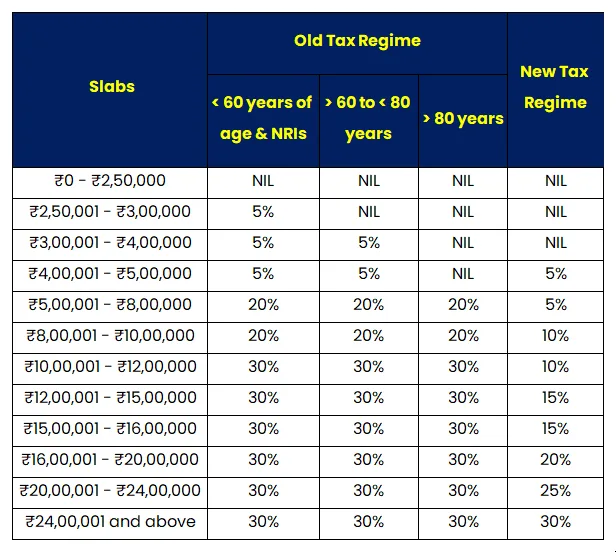
Tax Rates under Old & New Tax Regime
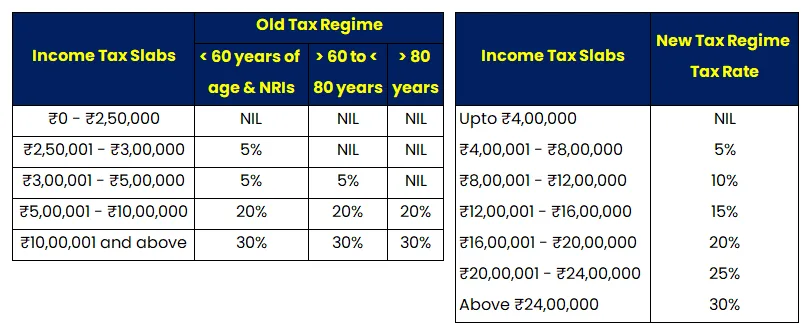
Step 5: Re-compute the Taxable Income & TDS
Throughout the tax year, an employer may need to re-calculate the employee’s taxable income and reassess TDS (Tax Deducted at Source). Why? Because things change and so must the TDS!
When and Why Does Re-computation Happen?
a. Revision Due to Salary Changes or Additional Income
At any point in the year, if an employee’s income changes, the TDS must be adjusted. This includes:
- Salary Hikes
- Bonuses/Incentives
- Arrears or Variable Pay
- Declared Income from Other Sources (like rent, interest, or freelance income)
In such cases, the revised total income must be computed, and the applicable tax liability should be recalculated for the remaining months of the financial year. TDS should then be adjusted accordingly.
B. Additional Income
An employee may subsequently provide details of:
- Interest income
- Rental income
- Other taxable income
- House property loss
Where such information is validly furnished and can be considered under Section 392, the employer should recompute the TDS.
C. Verification of Claims under Form No. 124
- Employees may provide declarations and supporting evidence for eligible exemptions and deductions through Form No. 124.
- The employer should consider the prescribed evidence while determining the final TDS liability.
- If the employee’s actual eligible claim is lower than the amount initially considered, taxable income will increase and additional TDS may be required.
- If additional eligible claims are properly supported and permissible, taxable income may decrease.
Approaches to TDS Adjustment
There are two practical methods adopted by employers to adjust TDS:
Method 1: Single Adjustment in March
- Final declaration and proofs are submitted by March.
- The shortfall in TDS is recovered entirely from the March salary.
- This may result in a higher deduction in the last month.
Method 2: Staggered Adjustment (January–March)
- Proof collection starts in January.
- Any excess or shortfall in TDS is adjusted evenly over the remaining three months.
- This approach eases the burden of deduction in the final month.
Step 6: Remittance of TDS to the Government
Once TDS is deducted from salary, the employer is required to deposit the tax with the Central Government within the prescribed time.
Failure to deduct or deposit TDS within the prescribed time may result in interest and other consequences under the applicable provisions.
The Income Tax Department has retained the overall TDS framework while consolidating TDS provisions under the Income-tax Act, 2025. Salary TDS is now covered under Section 392, while other TDS provisions are consolidated primarily under Section 393.
Due Dates for TDS Payment
- The employer must deposit salary TDS within the prescribed due date applicable to the relevant month.
- The applicable payment and compliance requirements should be checked based on the relevant Tax Year and prescribed rules.
- Important: The due date applicable to salary TDS should not be confused with the due date for filing the quarterly TDS statement.
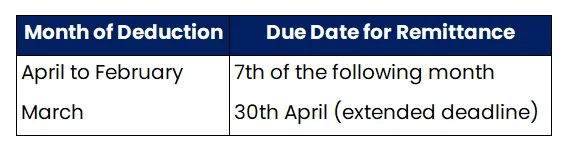
Proper remittance of TDS is essential for both the deductor (the entity deducting TDS) and the deductee (the payee from whom TDS is deducted). It ensures accurate tax compliance and prevents legal and financial issues in the future.
Modes of TDS Remittance
1. Online Payment (Recommended)
- Through the Income Tax e-filing portal
- Payment can be made via net banking, debit card, or authorized bank accounts
- Upon payment, a Challan Identification Number (CIN) is generated, which acts as proof of remittance
2. Offline Payment via Authorized Banks
- Challan is filled manually and submitted at designated banks along with cash/cheque/DD
- A stamped counterfoil of the challan is provided as acknowledgment
3. Third-Party E-payment Portals
- Employers may also use authorized fintech platforms or accounting software to automate TDS filing and payment
- These platforms generate the necessary challan and integrate with compliance systems